If you send money abroad, it helps to understand the mid-market exchange rate. Some people call it the real exchange rate. Others call it the interbank rate. Either way, it works as a benchmark for currency exchange.
Once you understand this rate, it becomes easier to see whether a provider is giving you a fair deal. You can compare the rate you see online with the rate offered at checkout. You can also spot when a “low fee” transfer may still cost more than it looks.
Mid-market rate matters because most people don’t send money for fun. They send it for rent, groceries, school fees, family support, or bills back home. So every part of the cost should be clear before they pay.
The transfer fee matters. But the exchange rate can matter even more.
What is the mid-market exchange rate?
The mid-market exchange rate is the midpoint between the price at which people are willing to buy a currency and the price at which they are willing to sell it.
Put simply, it’s the market reference rate before a provider adds its own margin.
Here’s an easy example.
If one side of the market is buying $1 for 3.66 AED and the other side is selling $1 for 3.68 AED, the mid-market rate is 3.67 AED.
That does not mean every person will get 3.67 AED when they send money. Most providers add a margin to the rate. But the mid-market rate gives you a fair starting point.
The Bank of Canada explains that exchange rates are shaped by the foreign exchange market, where currencies are bought and sold. It also notes that the rate shown by a bank or provider may differ from a market reference rate.
That is why the mid-market rate is useful. It helps you see the gap between the market rate and the rate offered to you.
Why does the mid-market rate matter?
The mid-market rate matters because the visible fee is not always the full cost.
A service may charge a small fee but offer a weaker exchange rate. That weaker rate means the receiver gets less money at the end. This is one of the most common ways people lose money on an international money transfer.
Let’s say you are sending $500. The transfer fee may only be $3. That sounds fair. But if the provider gives you a weaker rate, the receiver may lose much more than $3 by the time the money arrives.
The Consumer Financial Protection Bureau says remittance providers must disclose key details to users, including fees, the exchange rate, fees charged by certain agents or institutions, and the amount expected to be delivered.
People should not have to guess the real cost. They should see the fee, the rate, and the final amount before sending.
How exchange rate markups work
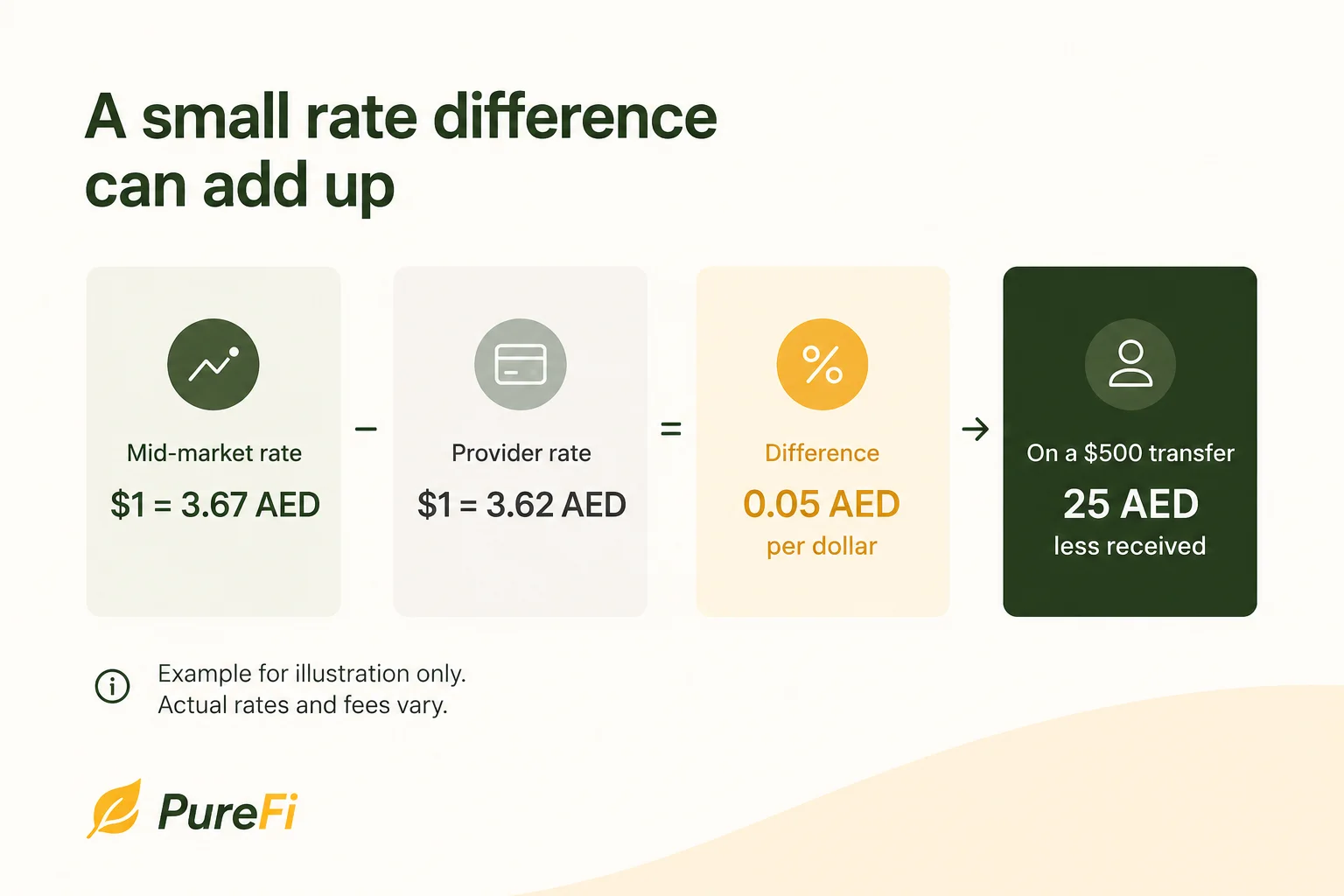
An exchange rate markup is the difference between the mid-market rate and the rate your provider gives you.
Here’s a simple example.
| Item | Example |
|---|---|
| Mid-market rate | $1 = 3.67 AED |
| Provider rate | $1 = 3.62 AED |
| Difference | 0.05 AED per dollar |
| Transfer amount | $500 |
| Exchange rate cost | 25 AED |
In this example, the sender may feel like they are only paying the visible transfer fee. But the receiver gets 25 AED less because of the exchange rate.
This is also why people search for how to avoid currency conversion fees. They are not only trying to avoid one of the listed charges. They are trying to avoid the quiet cost that can be embedded in the rate.
How to check if you’re getting a fair exchange rate
You don’t need to be a finance expert to check if a rate is fair. Start by looking up the current mid-market rate from a trusted currency source. Then compare it with the rate your transfer provider shows before checkout.
The rate will not always match exactly. Providers may need to cover their own costs. That is normal. But the difference should be clear enough for you to understand.
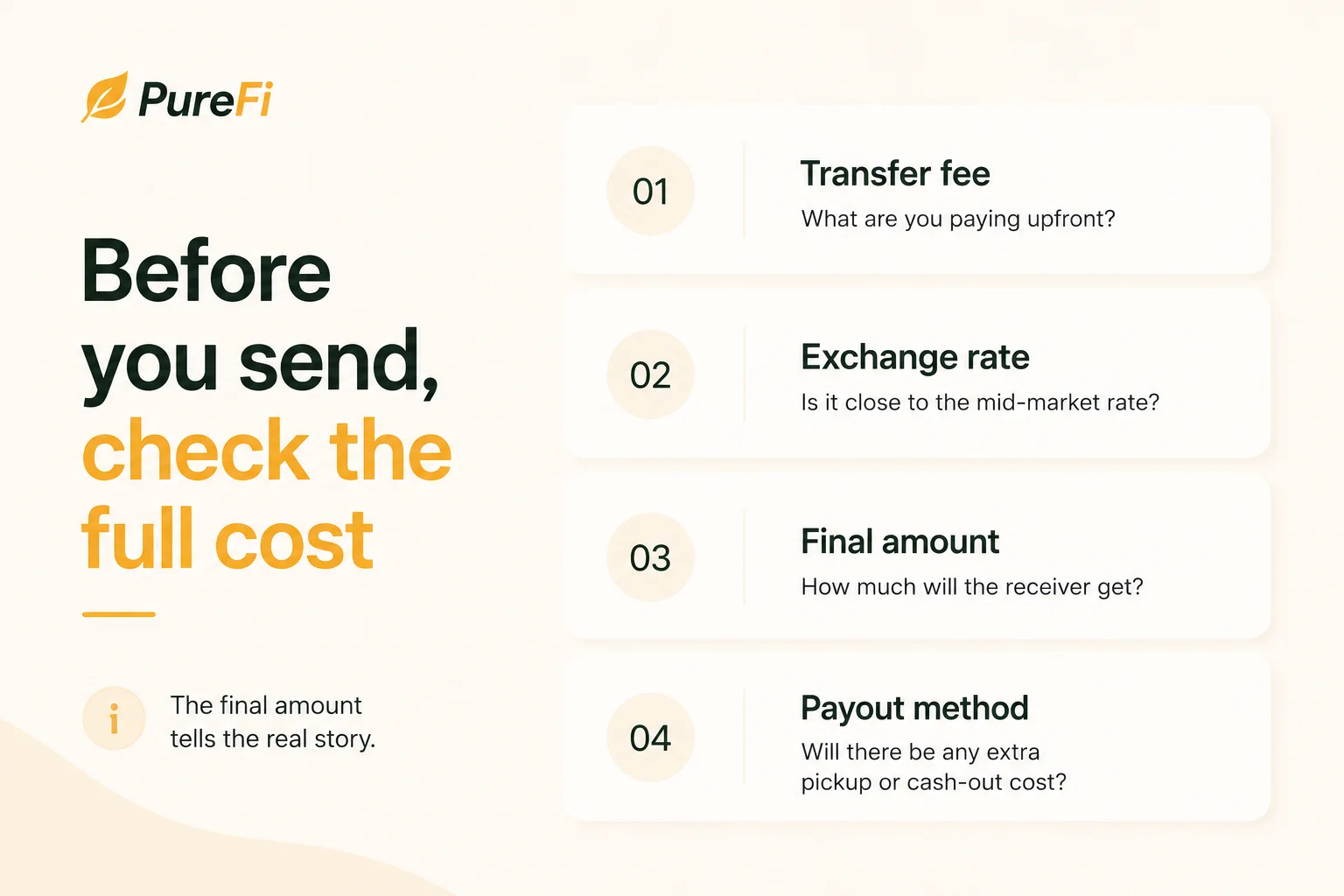
How much the receiver gets matters most. If one provider charges a slightly higher fee but gives a much better exchange rate, it may still cost less overall. If another provider says “no fee” but gives a poor rate, it may cost more than it looks.
The European Central Bank publishes euro foreign exchange reference rates every working day through a process with central banks across Europe. These are reference rates, not customer transfer rates, but they show why market reference rates matter when comparing currency prices.
Why exchange rates matter for people who send money often
A small exchange rate difference may not feel like much once. But if you send money every month, it adds up.
For many families, this is not extra money. It is rent, groceries, school fees, medical support, or help for parents back home. Every dollar matters when someone works hard to earn it.
Let’s say a person sends $500 every month. If they lose $7 each time through a weaker exchange rate, that is $84 in one year. If they lose $10 each time, that is $120 in one year.
That money could have stayed with the family. A fair transfer should make the cost clear before the sender pays. It should not hide the real price inside a confusing rate.
How PureFi thinks about exchange rates and fees
At PureFi, we believe people deserve a fair and transparent way to send money abroad.
Fees, rates, and hidden fees should be easy to understand. People who send money abroad are already carrying responsibility. The system should not make it harder for them to keep more of what they earn.
Before someone sends money, they should know what they are paying, what rate they are getting, and what the receiver will get. That is how money should work. Simple, honest, and on your side.
The traditional system often overcharges and underserves. We don’t do either one. We use new technology to make cross-border transfers faster, clearer, and easier to understand.
Conclusion
The mid-market exchange rate gives people a way to question the price they’re being offered. Most people are not sending money abroad as a one-time task. They’re supporting parents, helping children, paying bills, covering rent, or keeping family life steady across borders.
A small gap in the exchange rate may look harmless for a single transfer. Over time, it can take real money away from the people it’s meant to reach.
That is why fair pricing should be simple to see. If a provider is on your side, the cost should be clear before you send, not discovered after the money is gone.
Get PureFi for money transfers
PureFi helps you send money abroad for less, with clear fees and a simple way to hold and grow your money. We use new technology to make cross-border transfers faster, fairer, and more transparent.
Learn more about how PureFi can help you send, save, and grow money across borders, or download the app to get started today.