A euro account lets you hold, receive, send, and exchange euros without converting every payment into your home currency.
It can be useful when you work with European clients, travel across the eurozone, pay bills in Europe, or support family in another country. Holding euros may also help you avoid unnecessary conversions when you expect to use the money in euros later.
You don’t always need to live in Europe to open one. Depending on your location, you may be able to open a digital multi-currency account online, add a euro balance, and manage it through an app.
This guide explains how to open a euro account, what documents you may need, and how to choose an option that best fits how you use euros.
What is a euro account?
A euro account is an account or balance that holds money in euros.
For example, a freelancer in the US may receive €1,000 from a European client and keep the payment in EUR. They can use the euros to pay a contractor in Europe, cover travel costs, or convert the balance into dollars later.
This is different from receiving euros into an account that immediately converts the payment into another currency. With a euro balance, the money can stay in EUR until you decide what to do with it.
You may also see euro accounts described as foreign exchange accounts, international currency bank accounts, or multi-currency bank accounts. The names may differ, but each option is designed to help users manage foreign currencies.
Some euro accounts include an IBAN, which is commonly used to identify accounts for payments across Europe. A euro balance is not always the same as a traditional European bank account. Before signing up, check whether the provider gives you personal account details, supports incoming payments, and offers the services you need.
Who may need a Euro account?
A euro account is most useful when you regularly receive, send, or spend euros.
Travelers
Travelers can use a euro balance to pay for hotels, transport, food, and other costs in eurozone countries. Keeping money in EUR may reduce the need to convert each purchase separately. However, card fees, ATM charges, and the provider’s exchange rate can still affect the final cost.
Freelancers and remote workers
Freelancers working with European clients may use a euro account to receive international payments in EUR.
Without one, an incoming payment may be converted into the freelancer’s home currency as soon as it arrives. If the freelancer later needs euros, the money may have to be converted again. Holding the original payment in EUR can make it easier to pay European expenses without a second conversion.
Families using money across borders
A euro account can help people receive family support, pay tuition, cover rent, or send regular payments to someone in Europe. It may be especially helpful when the same person receives and spends euros. Instead of converting the money each time, they can keep it in the currency they plan to use.
People moving to Europe
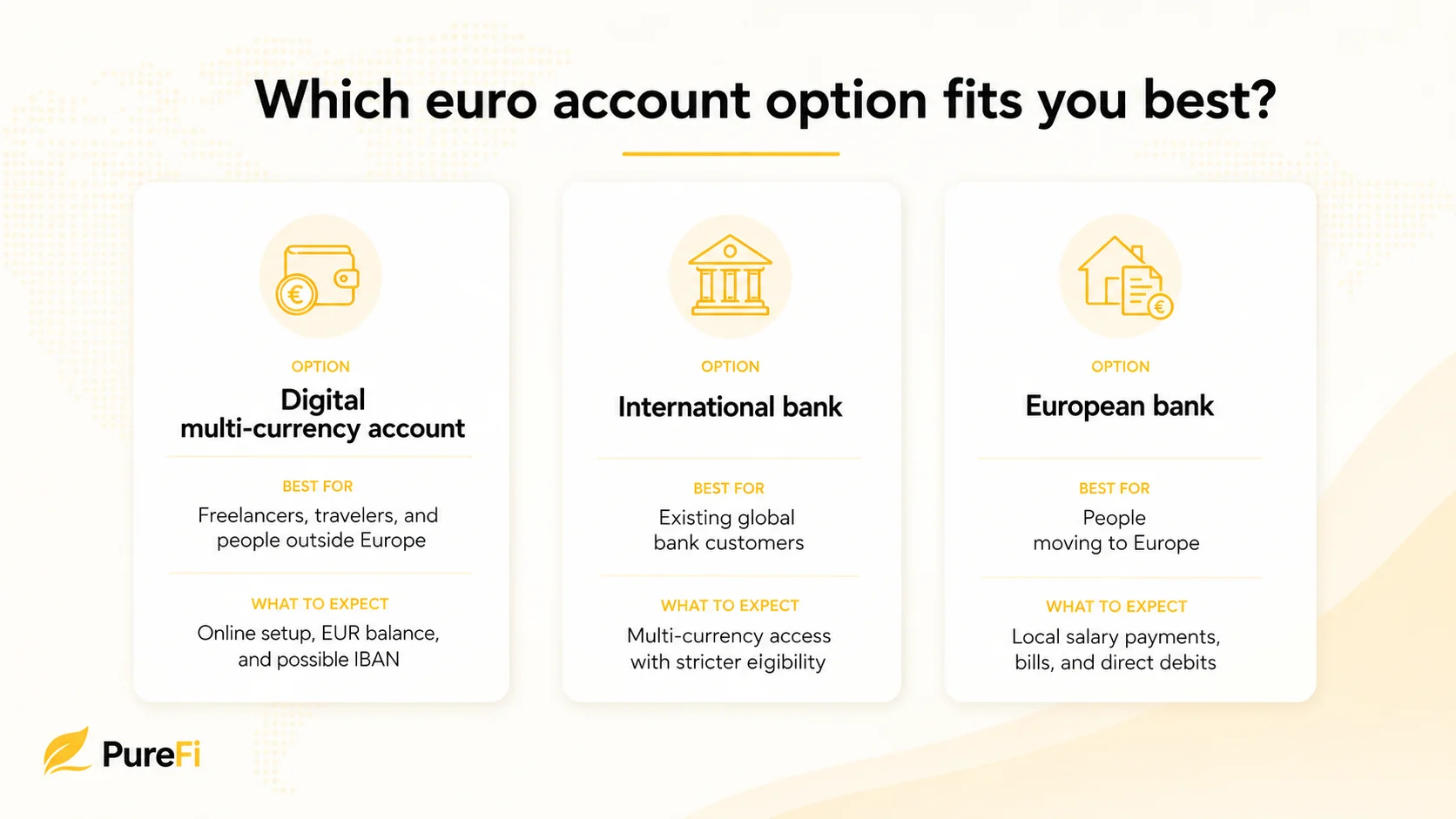
Someone moving to Europe may need euros for rent, utilities, transport, and other daily costs. A digital euro account can help during the transition. After relocating, a traditional local account may be more suitable for salary payments, direct debits, and other services that require local banking details.
Can you open a Euro account outside Europe?
Yes. Many digital providers allow eligible customers to open a euro balance without living in the EU.
The features available will depend on where you live. Some customers may receive an IBAN and a card. Others may only be able to hold EUR, exchange currencies, or make certain international transfers.
Wise allows eligible users to add supported currencies, including EUR, and to request account details after completing the required setup and identity checks.
Revolut also offers EUR account details in supported markets, but the IBAN and account features can vary by country. For example, some European customers receive local IBANs, while others may use an IBAN issued through another European branch.
Under the EU Payment Accounts Directive (2014/92/EU), consumers who are legally resident in the European Union have the right to apply for a basic payment account, even if they live in another EU country. Banks can still refuse an application in certain circumstances allowed by law.
Where can you open a Euro account?
You can open a euro account through a digital provider, an international bank, or a traditional European bank. The right option depends on your country, the documents you have, and how you plan to use EUR.
Digital multi-currency providers
A digital multi-currency account is often the easiest option for someone living outside Europe.
These services usually allow users to register, verify their identity, and add a euro balance online. Some also provide account details for receiving EUR.
Digital providers are convenient, but they don’t all have the same legal status. Some are banks in certain countries. Others are financial technology companies that provide services through licensed partners.
International banks
Some international banks offer accounts that support several currencies, including euros. These accounts may suit people who already have a relationship with the bank and want to manage EUR alongside their existing accounts.
They can also be useful for customers who prefer access to branches, phone support, or a wider range of traditional banking services. However, eligibility requirements may be stricter. Some banks require an existing account, a minimum balance, or an application through a specific country office.
Traditional European banks
A traditional European bank account may be the most practical option if you are moving to Europe for work, study, or long-term residence. It may support salary payments, direct debits, rent, utilities, and other everyday services. Local banks may also offer credit products and branch support that are not available through a simple euro balance.
The application process may require a European address, proof of residence, local tax information, or a valid visa. Requirements vary between countries and banks.
What documents do you need to open a Euro account?
The requirements vary by provider, but most applications ask for the same basic information.
Government-issued identification
You will usually need a valid passport, national identity card, or driving license. Your name and date of birth must match the details entered in your application. A provider may reject an expired, damaged, or unclear document.
Proof of address
You may be asked to provide a utility bill, bank statement, tenancy agreement, tax letter, or another official document showing where you live. Some providers only request this during additional checks. Others require it from every applicant.
Tax information
The provider may ask for your country of tax residence and tax identification number. Financial companies collect this information to meet identity, reporting, and compliance requirements. Providing tax details does not automatically mean you owe tax simply because you opened a euro account.
A selfie or video check
Digital providers may ask you to take a live photo or record a short video. This allows them to compare your face with your identity document and confirm that someone else is not opening the account in your name.
Information about your money
You may be asked where your funds come from or how you plan to use the account. For example, you might use it for client payments, a salary, personal savings, travel, or family support. These questions are a normal part of account verification.
How to open a Euro account online
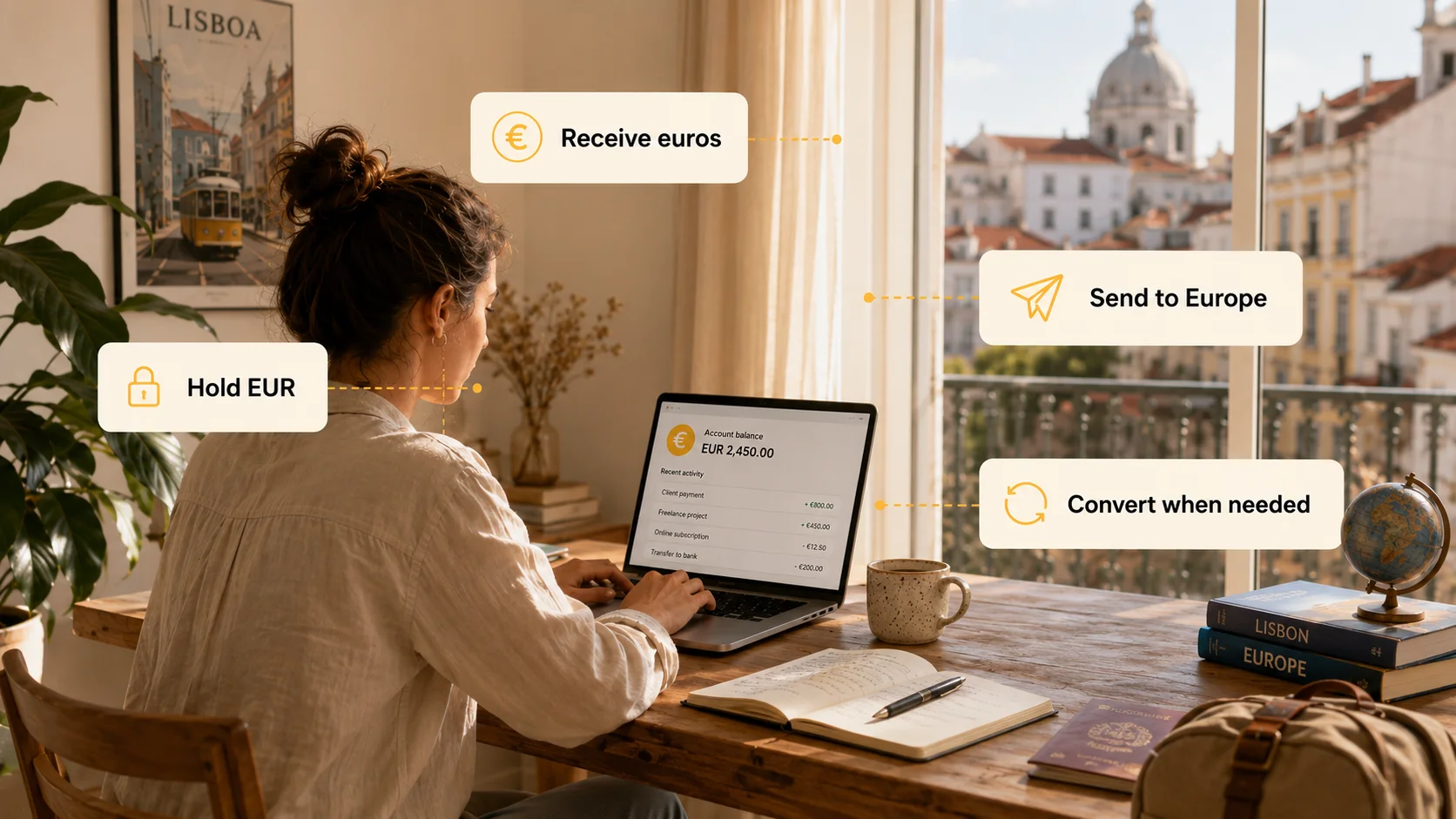
Most digital euro accounts can be opened through a website or mobile app.
1. Check whether the provider supports your country
Start by confirming that the service accepts customers in your area.
Then check which EUR features are included. Being able to hold euros does not always mean you can receive them via IBAN, order a card, or make all types of euro payments.
2. Create your account
Register using your legal name, phone number, email address, date of birth, and home address. Use the same spelling shown on your identification documents. Differences may delay verification.
3. Complete identity verification
Upload the requested ID and complete any selfie or video check. You may also need to provide proof of address, tax information, or details about how you plan to use the account.
4. Add a Euro balance
Once your account has been approved, select EUR from the list of supported currencies. The provider may describe this step as adding a currency, opening a balance, or activating a euro account.
5. Find your Euro account details
Open the EUR section and check whether the provider has issued an IBAN or other receiving details.
An IBAN is a standard format used to identify accounts for cross-border payments. It can contain between 15 and 34 characters, depending on the issuing country.
6. Add funds or receive euros
You can add money from another account or share your Euro details with someone who needs to pay you. Before accepting a large payment, confirm that the sender is using the correct account name, IBAN, payment reference, and currency.
How PureFi helps you manage euros across borders
PureFi gives you one place to hold, send, and receive supported foreign currencies. You can manage your account online without visiting a branch or dealing with unclear charges.
Hold euros alongside other currencies
A PureFi multi-currency account lets you keep supported foreign currencies in one account experience. This can help when you receive money in one currency but plan to spend it or transfer it elsewhere.
You decide when to exchange supported balances, rather than converting every payment as soon as it arrives.
Receive supported international payments
PureFi is built to make receiving money from abroad simpler. You can follow incoming payments and see transaction updates in one place. There are no hidden receiving charges added without explanation.
Available currencies, routes, and receiving details depend on your country and account eligibility.
Send euros to supported countries
PureFi supports international transfers in major currencies, including EUR. You can send euros through supported routes to countries such as Germany, France, Spain, and Italy.
Before confirming a transfer, you can check the rate and see how much the recipient is expected to receive.
See the cost before you send
PureFi shows the exchange rate and transfer details before you confirm a supported payment. This helps you understand the transaction costs without having to search for hidden terms later.
*Disclaimer: PureFi is a financial technology company, not a bank. We provide bank-like services through licensed technology partners. Euro balances, receiving details, cards, and transfer routes may vary by country and account eligibility. Check the PureFi app for the services currently available in your location.
Learn more about how PureFi can help you send, save, and grow money across borders, or download the app to get started today.