People send money across borders every day. They pay family members, cover tuition fees, pay suppliers, or receive money from overseas. Most of these payments happen without people thinking about what happens behind the scenes.
The truth is that sending money to another country is often more complicated than sending money within the same country. Banks don’t always have branches, offices, or accounts everywhere in the world. That means they sometimes need help from other banks to transfer money between countries.
This system is called correspondent banking. It has been used for many years to support international remittances, business payments, and other cross border payments. Even though you may never see it, correspondent banking helps make it possible to send money abroad to places where your bank doesn’t operate directly.
Understanding how it works can also help you understand why some international transfers take longer, why fees can vary, and what it really costs to send money overseas.
What is correspondent banking?
Correspondent banking is an arrangement between two banks in different countries.
Instead of opening branches worldwide, banks work with trusted partner banks. These partner banks help them send and receive money in places where they don’t have their own presence. The partner bank is called a correspondent bank.
Think of it as a trusted middle point between two banks. For example, a bank in the United States may need to send money to someone whose account is with a small bank in another country.
Since the two banks don’t have a direct relationship, they use a correspondent bank to help complete the transfer. This allows people and businesses to transfer money between countries even when their banks are thousands of miles apart.
Without correspondent banking, many international money transfers would be much harder to complete.
How does correspondent banking work?
Most international transfers follow a similar process.
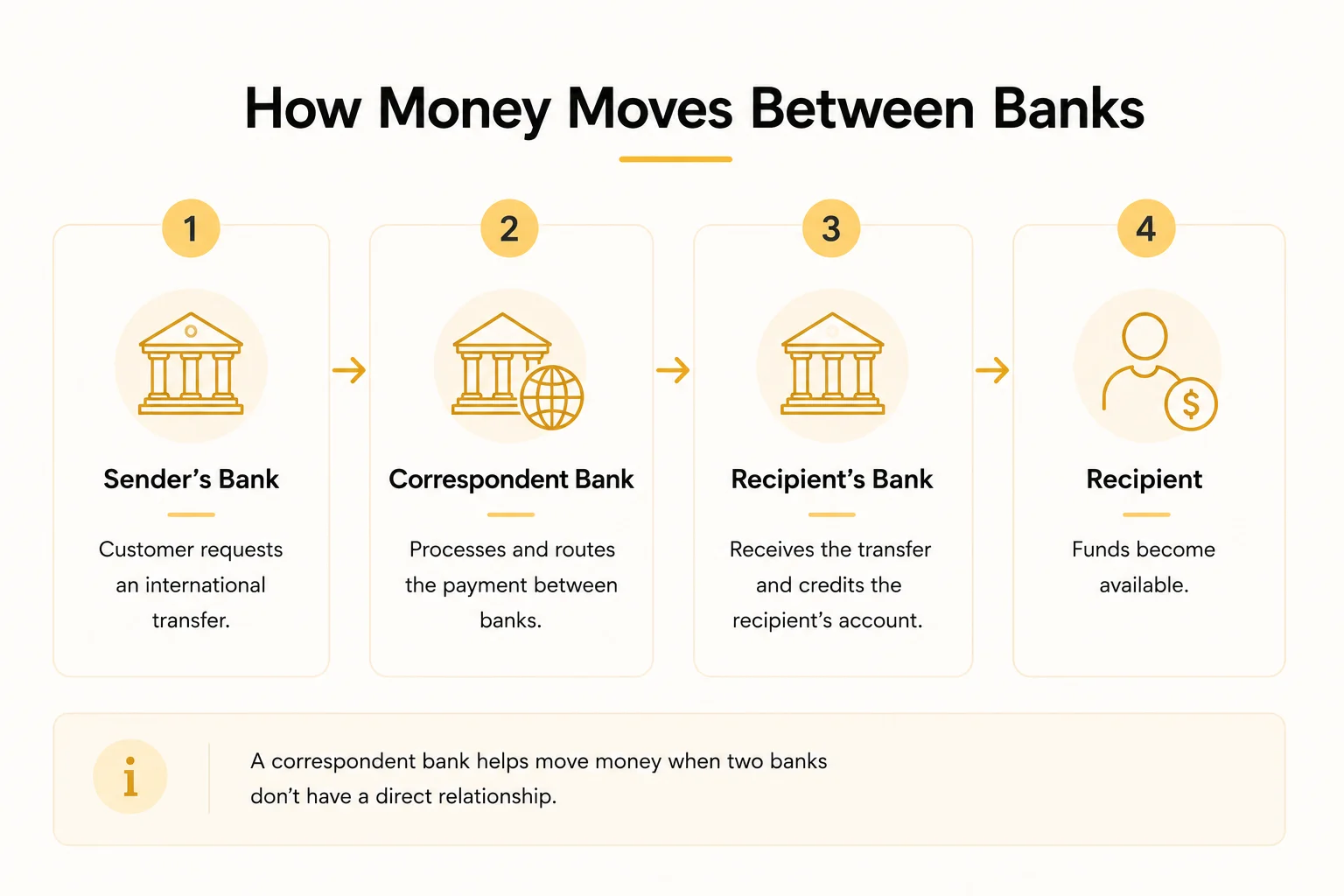
Step 1: You ask your bank to send the money
The process starts when you request an international money transfer. You provide the recipient’s details, the amount you want to send, and any other information your bank needs.
Step 2: Your bank looks for a banking partner
If your bank doesn’t have a direct relationship with the recipient’s bank, it sends the payment through a correspondent bank. This bank acts as a trusted partner and helps transfer the money to the next stage.
Step 3: The payment transfers between banks
The correspondent bank passes the payment to the recipient’s bank. In some cases, only one correspondent bank is needed. For transfers between certain countries or currencies, the payment may pass through more than one bank before reaching its destination.
Step 4: The recipient’s bank receives the money
Once the payment reaches the recipient’s bank, the funds are deposited into their account. The recipient can then access the money according to their bank’s normal processing times.
Although this process happens behind the scenes, every bank involved helps transfer the payment safely from one country to another. The number of banks involved can also affect the actual cost of sending money abroad and how long the transfer takes.
Why do banks need correspondent banking?
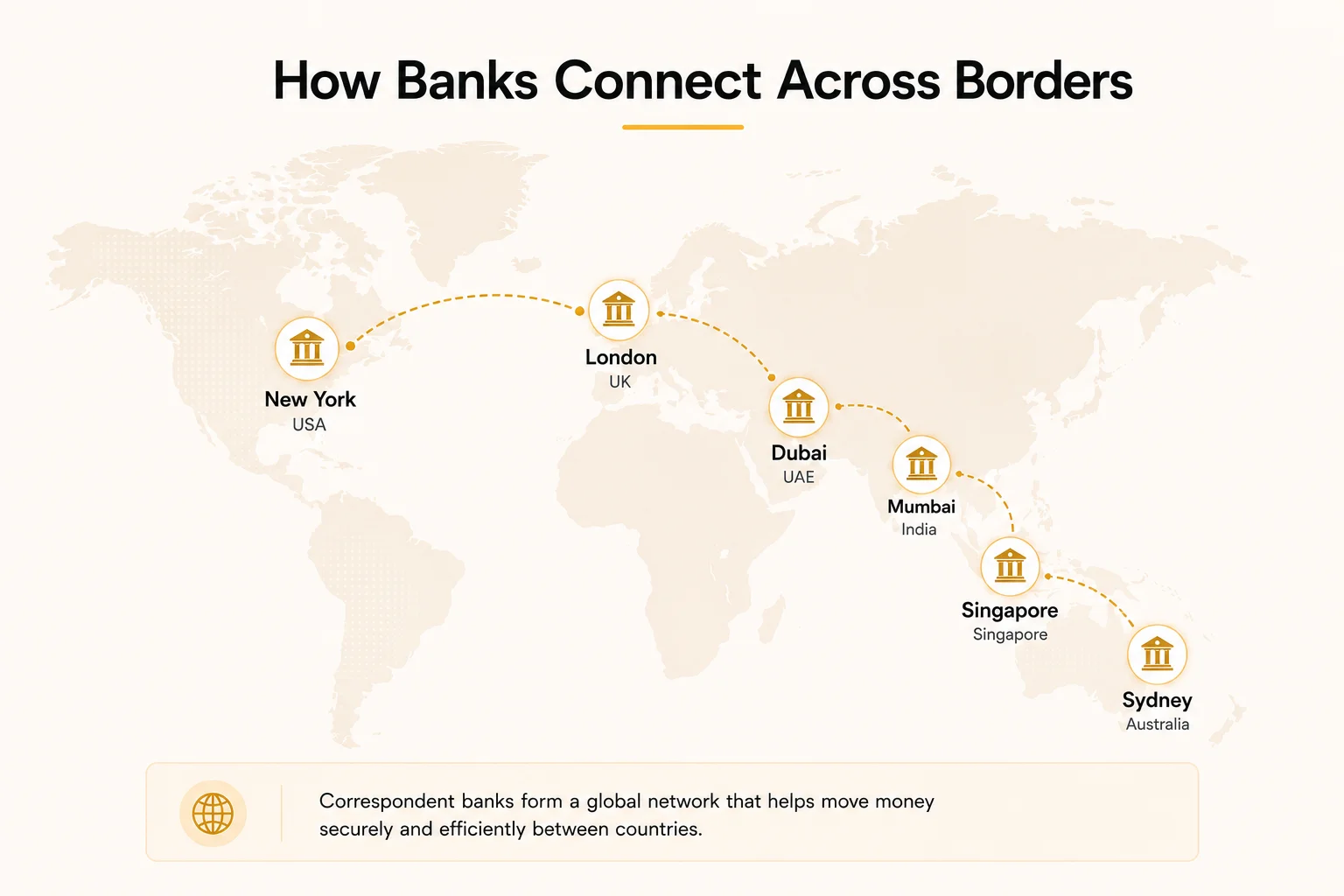
Banks don’t have branches or accounts in every country. Building and managing a global network would be expensive and difficult.
Instead, they work with correspondent banks that already have an established presence in different parts of the world. This allows them to offer international payment services without opening offices in every market.
International transfers often involve currency conversion. Depending on the payment route, one of the banks or financial institutions involved may convert the funds before they reach the recipient.
For example, a payment sent in U.S. dollars may need to be converted before it reaches the recipient. The banks involved help complete that process as the money transfers through the payment network.
Without correspondent banking, many cross border payments would simply not be possible. It helps banks connect with each other so people can send money abroad, receive payments from overseas, and transfer money between countries more easily.
Does correspondent banking affect transfer fees and delivery times?
It can. Every international transfer follows its own route. Some payments can be transferred directly between two banks, while others pass through one or more correspondent banks before reaching the recipient.
When more banks are involved, the transfer may take longer to complete. Each bank also has its own processing times, security checks, and operating hours.
Fees can vary for the same reason. Some banks charge a fee for handling international transfers, and currency conversion can also affect the actual cost of sending money. This is why two providers may charge the same transfer fee but deliver different final amounts to the recipient.
That’s why it’s always worth checking the total cost before confirming an international remittance, not just the fee shown at the start.
Is correspondent banking safe?
Correspondent banking is an established part of the global financial system and is generally considered a secure way to move money between banks. However, like any international payment system, it operates within strict regulatory and compliance requirements. In some higher-risk markets, banks have reduced correspondent banking relationships, which can affect where and how payments are processed.
For most people, correspondent banking works quietly in the background. You don’t need to do anything differently. The banks involved handle the process while your payment transfers from one country to another.
Conclusion
Correspondent banking is one of the systems that keeps money moving between countries. When two banks don’t have a direct relationship, a correspondent bank helps connect them so payments can reach their destination. Although most people never see this process, it plays an important role in many cross border payments. It can also affect how long a transfer takes and what it really costs, especially when several banks are involved.
Understanding how correspondent banking works makes it easier to understand international transfers and compare different ways to send money abroad. The more you know about how your money is transferred, the easier it is to choose a provider that is open about its fees, delivery times, and exchange rates.
Get PureFi for money transfers
PureFi helps you send money abroad for less, with clear fees and a simple way to hold and grow your money. We use new technology to make cross-border transfers faster, fairer, and more transparent.
Learn more about how PureFi can help you send, save, and grow money across borders, or download the app to get started today.