
Moving abroad changes more than where you live. It can also change how you manage your bank accounts in India.
Once you become a Non-Resident Indian, or NRI, you generally should not continue using a standard resident savings account in the same way. Your bank may ask you to redesignate the account as an NRO account or to open another account suitable for your non-resident status.
The two account types most NRIs come across are NRE and NRO accounts. This guide explains the difference between an NRE and NRO account and helps you decide which one may suit your needs.
What is an NRE account?
NRE stands for Non-Resident External.
An NRE account is an Indian rupee account created for NRIs who want to transfer income earned outside India into the country. You send the money in a foreign currency, and the bank converts it into Indian rupees before crediting the account.
For example, an NRI working in the UAE may transfer part of their salary to an NRE account in India. The funds may then be used for family expenses, investments, loan payments, or other permitted purposes.
What money can you deposit into an NRE account?
An NRE account is mainly funded with money earned outside India.
This may include:
- Salary earned abroad
- Personal savings held overseas
- Transfers from another NRE account
- Interest earned on certain eligible NRE deposits
The account is not mainly designed for income that arises within India. Indian income is usually managed through an NRO account instead.
Is an NRE account held in foreign currency?
No. An NRE account is held in Indian rupees.
Your foreign currency is converted into INR when it reaches the account. If you later transfer the money abroad, it is converted back into the destination currency.
This means the value of your money can change with exchange rates. Even when the amount in rupees stays the same, the amount you receive in another currency may rise or fall.
Can you transfer NRE funds abroad?
Yes. The principal and interest in an NRE account are generally fully repatriable. This means the funds can normally be transferred outside India, subject to the bank completing its usual checks.
This makes an NRE account useful for NRIs who want to send foreign income to India while keeping the option to transfer it back overseas later.
Is interest on an NRE account taxable in India?
Interest earned on an eligible NRE account is generally exempt from Indian income tax while the account holder continues to qualify under the relevant non-resident rules. However, your country of residence may apply its own tax rules. Tax-free treatment in India does not automatically mean the interest is tax-free everywhere.
Who may benefit from an NRE account?
An NRE account may suit you when:
- Your income is earned outside India
- You regularly send savings to India
- You want the option to transfer the money abroad again
- You want to use overseas earnings for expenses or investments in India
It is often the more suitable option for someone looking for an international remittance route into India while keeping the funds freely repatriable.
What is an NRO account?
NRO stands for Non-Resident Ordinary.
An NRO account is an Indian rupee account mainly used to manage income that comes from within India. It may also receive permitted overseas transfers, but its main purpose is to handle local Indian income while the account holder lives abroad.
For example, an NRI who owns a property in India may use an NRO account to collect rent. The same account may also receive pension payments, dividends, interest, or other income from Indian sources.
What money can you deposit into an NRO account?
An NRO account may receive income such as:
- Rent from property in India
- Pension payments from India
- Dividends
- Interest from Indian accounts or investments
- Sale proceeds from eligible assets
- Other permitted local income
Foreign funds may also be deposited into an NRO account through approved banking routes.
Can you keep your existing Indian account as an NRO account?
In many cases, an existing resident savings account may be redesignated as an NRO account after the account holder becomes a non-resident. You should inform your bank when your residency status changes. The bank can explain whether your current account can be converted and which documents are required.
Can you transfer NRO funds abroad?
NRO funds are not as freely repatriable as NRE funds. Current income, such as rent, dividends, pensions, and interest, may generally be transferred abroad after applicable taxes have been paid and the bank is satisfied with the supporting documents. Other eligible NRO balances may generally be repatriated up to USD 1 million per financial year, subject to RBI conditions, tax compliance, and bank checks.
Your bank may ask for tax forms, proof of the source of funds, or certification from a chartered accountant before processing the transfer.
Is interest on an NRO account taxable in India?
Interest earned on an NRO account is taxable in India and is normally subject to tax deduction at source.
The final rate may depend on Indian tax rules, your total income, and any tax treaty between India and your country of residence. It is best to confirm the treatment with a tax professional rather than relying only on the amount deducted by the bank.
Who may benefit from an NRO account?
An NRO account may suit you when:
- You receive rent from India
- You receive an Indian pension
- You earn dividends or interest in India
- You need to pay local bills from Indian income
- You want to keep managing an existing Indian account after becoming an NRI
It is usually the more relevant account when your money comes from inside India rather than from overseas.
NRE vs NRO account
The clearest difference is the source of the money. An NRE account is mainly for foreign income sent to India. An NRO account is mainly for income received within India.
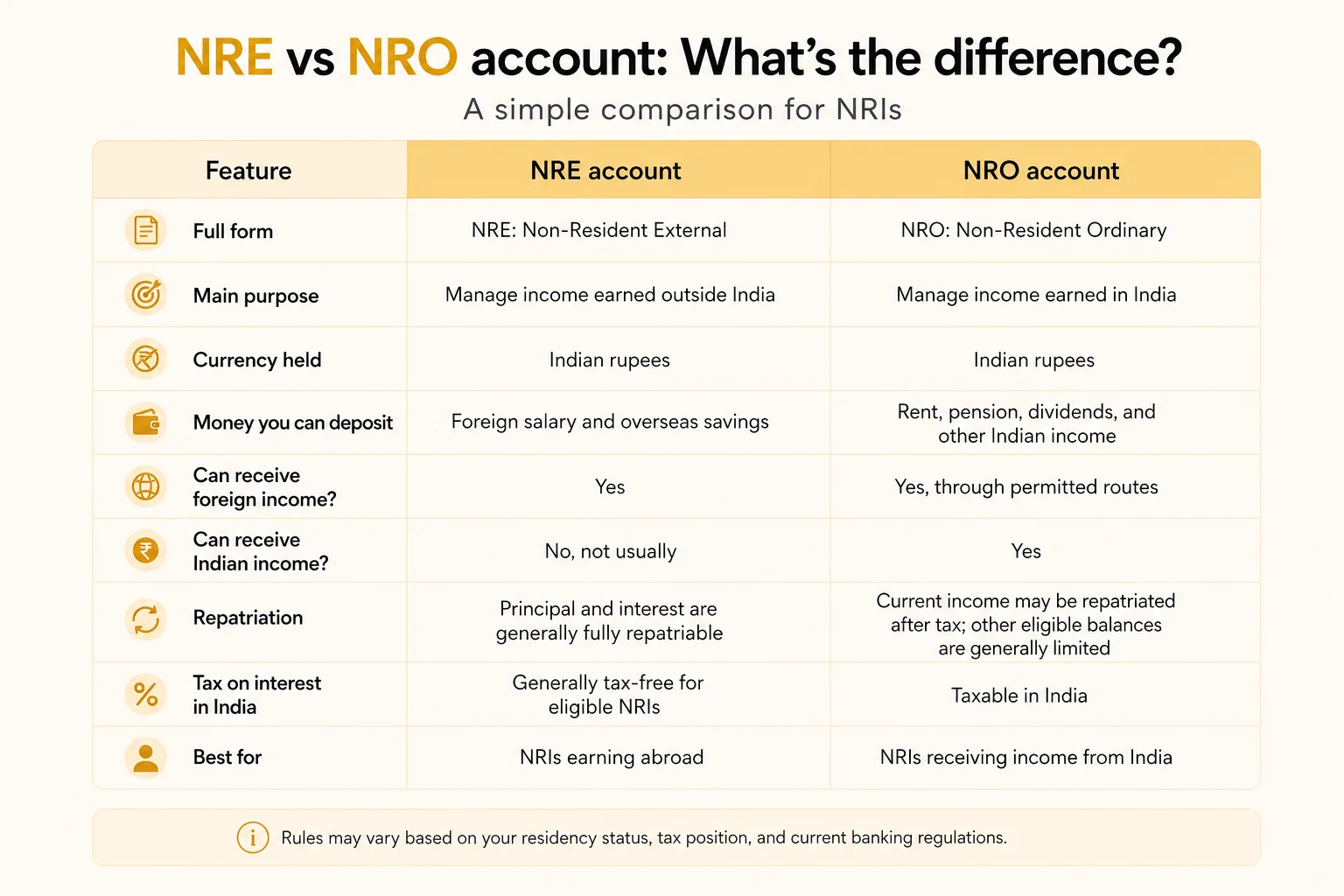
| Feature | NRE Account | NRO Account |
|---|---|---|
| Full form | Non-Resident External | Non-Resident Ordinary |
| Main purpose | Manage income earned outside India | Manage income earned in India |
| Deposit source | Foreign income | Indian income and permitted overseas transfers |
| Currency | Indian rupees (INR) | Indian rupees (INR) |
| Interest tax in India | Generally exempt while eligible | Generally taxable |
| Repatriation | Generally fully repatriable | Subject to RBI rules and limits |
| Best for | NRIs earning abroad | NRIs receiving income from India |
NRE vs NRO account: Which one is right for you?
The right account depends mainly on where your income comes from and what you plan to do with it.
Choose an NRE account when your income comes from abroad
An NRE account may be more suitable if you earn outside India and want to send part of that income home.
For example, you may use it to support family, pay a loan, save in India, or make permitted investments. It also gives you more flexibility if you may need to transfer the funds abroad again.
Choose an NRO account when your income comes from India
An NRO account may be the better choice if you receive rent, pension payments, dividends, or interest from India.
It gives you a place to collect local income and use it for expenses within the country. You may also transfer eligible funds overseas after meeting the required tax and documentation rules.
You may need both accounts
Many NRIs use both. You might use an NRE account for the salary and savings you send from abroad. At the same time, you might use an NRO account to collect rent or other Indian income. Keeping the accounts separate can make it easier to show where the money came from and understand which repatriation and tax rules apply.
How PureFi can support your cross-border finances
PureFi does not provide NRE or NRO accounts. These are Indian bank accounts that must be opened with an authorized bank in accordance with Indian banking rules.
PureFi can support other parts of your international finances through its USDC wallet and supported cross-border transfer services. You can hold and manage supported currencies, view exchange rates, and see transaction costs before confirming an available transfer.
PureFi may be useful when you need to:
Hold digital-dollar balances (where available)
You can keep supported USDC balances in one place before using supported transfer services. This may help NRIs who earn in one currency, spend in another, or manage payments across multiple countries.
Manage supported international transfers
PureFi lets users send money internationally online through available routes and track supported transfers digitally. Fees, exchange rates, transfer times, and country availability can vary by corridor.
See fees before confirming
PureFi shows the applicable rate and transaction details before you complete a supported transfer. This can help you understand the expected cost of your cross-border payments without waiting for the transaction to arrive.
Learn more about how PureFi can help you send, save, and grow money across borders, or download the app to get started today.